Most local service businesses don’t have a traffic problem.
They have a structure problem.
Their websites get visitors. Sometimes decent numbers. But those visitors leave without calling, without filling out a form, without booking anything. Google can’t figure out what the business actually does or where it operates. And the business owner keeps wondering why the phone isn’t ringing.
The answer is almost always the same: the website is built wrong.
Not visually wrong. Not ugly. Structurally wrong.
Consider how common this is:
- A plumber serving Queens, Flushing, and Jamaica has one page called “Services” — listing everything from drain cleaning to water heater installation in a single block of text
- A dental clinic in the Bronx has no location page, no borough-specific content, and no appointment booking path that makes sense on mobile
- A personal injury lawyer in Manhattan has a homepage, an About page, and a Contact page — and nothing else
- A roofing contractor in Long Island lists every service on one page with no dedicated content for roof repair, roof replacement, or storm damage claims
- A limousine company serving JFK, LaGuardia, and Newark has no airport-specific service pages — just a generic “Services” menu
In every one of these cases, the problem isn’t that the business is bad at what it does. The problem is that the website doesn’t communicate clearly to Google, and it doesn’t guide customers toward taking action.
Google needs to understand what you do, where you do it, and who you serve — before it will send you traffic. And when traffic does arrive, your website needs to move people from “I found this business” to “I’m calling right now.”
A strong website structure solves both problems at once.
This guide breaks down exactly how to structure a local service business website — so it ranks, converts, and generates leads consistently.
What Is Website Structure for Local SEO?
Website structure for local SEO is the way a local business organizes its pages, services, locations, navigation, internal links, and calls-to-action so that search engines and customers can both understand what the business does, where it operates, and how to contact it.
It is not just about how your website looks. It is about how your website is organized underneath — which pages exist, how they connect to each other, what each page is about, and how a visitor moves from landing on your site to becoming a lead.
Website structure affects five things that matter directly to your business:
Google crawling. Search engines follow links between your pages to discover and index your content. If your pages are poorly connected or buried, Google may never fully index them.
Search intent matching. Every page on your website should match a specific type of search. A page about AC repair should rank for AC repair searches. A page about AC repair in Brooklyn should rank for that specific local search. One generic page cannot serve all intents at once.
Local relevance. Google needs geographic signals to understand where your business operates. Location pages, city-specific content, and service-area mentions all contribute to local ranking signals.
User experience. A well-structured website guides visitors naturally toward the information they need and the action you want them to take. A poorly structured website confuses people and loses them.
Conversion. Structure is the foundation of lead generation. Without clear calls-to-action, logical page flow, and visible contact options, even high-traffic websites generate very few leads.
AI search extraction. AI engines like ChatGPT, Perplexity, and Google’s AI Overview pull answers from websites that are clearly organized, well-labeled, and easy to parse. Poor structure means your business gets ignored by these tools entirely.
Why Website Structure Matters for Local Service Businesses
Google is trying to answer a simple set of questions when it crawls your website. If your site can’t answer these questions clearly, Google won’t rank it well — and customers who find it won’t know what to do next.
The six questions Google needs your website to answer:
- What services do you offer?
- Where do you offer them?
- Who do you serve?
- Why should customers trust you?
- How can customers contact you?
- What should they do next?
A website with poor structure answers none of these clearly. A website with strong structure answers all six — and makes the answers easy for both Google and real people to find.
Here is the difference in practice:
| Poor Website Structure | Strong Website Structure |
| One generic “Services” page | Dedicated page for each core service |
| No location or city pages | City, borough, and service-area pages |
| Phone number buried in the footer | Click-to-call button visible on every page |
| No links between related pages | Strategic internal linking throughout |
| Thin content that covers nothing in depth | Helpful, specific content on each page |
| No clear next step for visitors | Lead capture funnel on every key page |
| No trust signals | Reviews, certifications, and case results displayed |
| Blog disconnected from services | Blog content linking directly to service pages |
Every row in that table represents a ranking opportunity missed, a lead lost, or a customer who chose a competitor instead.
Not sure if your website structure is hurting your Google rankings? Request a Website Redesign Audit and find out exactly where leads are being lost.
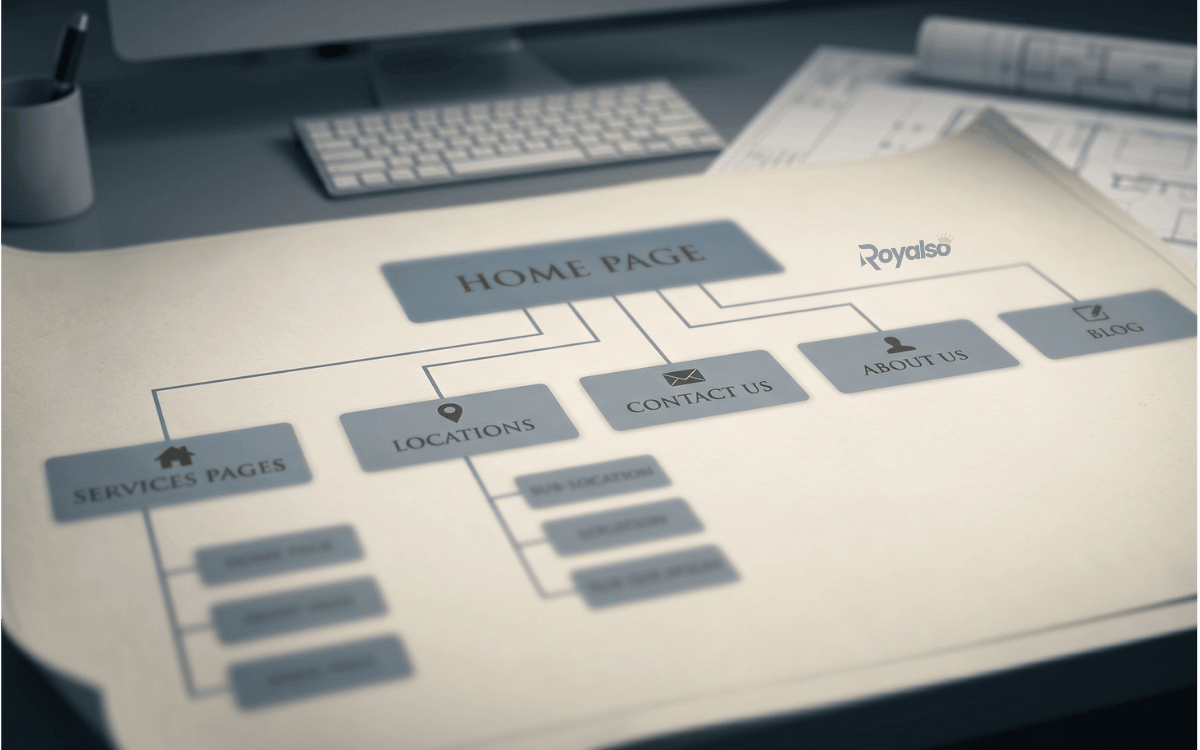
The Ideal Website Structure for Local Service Businesses
A well-structured local business website follows a clear hierarchy. Each level of the hierarchy serves a different purpose — for search engines and for customers.
Here is the architecture that works:
Homepage
Purpose: Establish trust immediately, communicate your core value, and direct visitors toward the right service or location.
Your homepage is not the place to explain everything. It is the place to establish clarity fast and move people deeper into the site.
A strong local service business homepage includes:
- A clear headline that states what you do and where you do it
- Your primary service area (city, borough, or region)
- Your main services with links to dedicated service pages
- Trust signals: years in business, licenses, certifications, awards
- Customer reviews or star rating display
- A primary CTA: call now, get a quote, or book a consultation
- Multiple contact options: phone, form, and chat if applicable
- Internal links to your most important service pages and location pages
Example for a Brooklyn HVAC company:
Headline: “HVAC Installation, Repair & Maintenance in Brooklyn, NY”
Subheadline: “Trusted by 2,000+ homeowners across Brooklyn, Queens, and Long Island”
Main Service Pages
Purpose: Rank for broad service category searches and guide users toward the specific service they need.
Every major service your business offers deserves its own dedicated page. Not a section on a page — a full page.
Examples by business type:
- HVAC: HVAC Services, Heating Services, Cooling Services, Indoor Air Quality
- Plumbing: Plumbing Services, Drain Services, Water Heater Services
- Roofing: Roofing Services, Residential Roofing, Commercial Roofing
- Law: Practice Areas, Personal Injury, Criminal Defense, Family Law
- Dental: Dental Services, Cosmetic Dentistry, Restorative Dentistry
- Limo: Limo Services, Corporate Travel, Wedding Transportation, Airport Transfers
These pages rank for broader terms and serve as hubs that link down to more specific service pages.
Specific Service Pages
Purpose: Match high-intent, specific search queries and convert visitors who know exactly what they need.
Specific service pages are where the real local SEO value lives. A potential customer searching for “boiler installation Brooklyn” or “emergency plumber Queens” has high intent. They are ready to hire. A dedicated page built around that exact topic gives Google a clear signal and gives the customer exactly what they came for.
Examples:
- HVAC: AC Repair, Boiler Installation, Furnace Replacement, Heat Pump Service, AC Tune-Up
- Plumbing: Emergency Plumbing, Drain Cleaning, Water Heater Installation, Leak Detection, Sewer Line Repair
- Roofing: Roof Repair, Roof Replacement, Flat Roof Installation, Roof Inspection, Storm Damage Repair
- Law: Car Accident Lawyer, Slip and Fall Attorney, Workers Compensation, Medical Malpractice, Wrongful Death
- Dental: Dental Implants, Invisalign, Root Canal, Teeth Whitening, Dental Crowns
- Limo: Airport Car Service, JFK Limo Service, Corporate Chauffeur, Wedding Limo, Prom Transportation
One generic services page cannot rank for all of these queries. Individual pages can — and do.
Location Pages
Purpose: Signal geographic relevance to Google and rank for “[service] in [city]” searches.
If your business serves multiple cities, boroughs, or neighborhoods, each major area deserves its own location page.
Examples:
- Plumber in Queens
- HVAC Company in Brooklyn
- Roofer in Long Island
- Personal Injury Lawyer in Manhattan
- Dental Clinic in the Bronx
- Limo Service in Staten Island
Important: Location pages must have genuine, useful content for each area. Thin pages that just swap out the city name are a waste of time and can actually hurt rankings. Each location page should include: local landmarks or references, area-specific service examples, nearby service areas, real reviews from customers in that area, and a clear contact/quote CTA.
Service + Location Pages
Purpose: Capture the highest-intent local searches — users who know exactly what they want and exactly where they want it.
These are the most powerful pages for local lead generation when executed properly.
Examples:
- AC Repair in Brooklyn → /ac-repair-brooklyn/
- Emergency Plumber in Queens → /emergency-plumber-queens/
- Roof Repair in Long Island → /roof-repair-long-island/
- Car Accident Lawyer Manhattan → /car-accident-lawyer-manhattan/
- Dental Implants NYC → /dental-implants-nyc/
- JFK Airport Limo Service → /limo-service-jfk-airport/
A search for “emergency plumber in Queens” comes from someone who has a pipe leaking right now. If your website has a dedicated page for that exact topic, you have a real shot at that lead. If you don’t, you don’t.
Blog and Resource Center
Purpose: Build topical authority, answer buyer questions, and capture informational search traffic that leads to service inquiries.
A blog connected to your service pages does two things: it signals to Google that your site is a credible authority on your topic, and it attracts people who are researching before they hire.
High-value blog topics for local service businesses:
- “How Much Does Roof Repair Cost in New York?”
- “Emergency Plumbing Checklist for Homeowners”
- “What to Look for Before Hiring a Personal Injury Lawyer”
- “HVAC Maintenance Schedule for New York Winters”
- “Airport Limo vs Rideshare: What Makes Sense for Business Travel?”
Every blog post should link naturally back to the relevant service page or location page.
Contact, Quote, and Booking Pages
Purpose: Convert visitors into leads.
Every important page on your site should point toward one of these pages — or contain a contact option directly. Contact options to include depending on your business type:
- Call now (click-to-call on mobile)
- Request a free quote
- Book a consultation
- Schedule an appointment
- Request a free inspection or audit
The contact page should never be the only place where visitors can reach you. Every service page, every location page, and every blog post should have a conversion path built in.
Recommended Website Structure by Business Type
Different service businesses have different page needs. Here is a practical page map for four of the most common categories.
Contractors (HVAC, Plumbing, Roofing, Electrical)
Recommended pages:
- Home
- About / Our Team
- Services (hub page)
- Individual service pages (one per service)
- Service area / location pages
- Project gallery or before/after photos
- Reviews / testimonials page
- Blog
- Contact / Get a Quote
Example URL structure for a roofing contractor:
- /services/roof-repair/
- /services/roof-replacement/
- /services/flat-roof-installation/
- /services/storm-damage-repair/
- /locations/brooklyn/
- /locations/queens/
- /locations/long-island/
- /roof-repair-brooklyn/
- /roof-replacement-queens/
- /emergency-roof-repair-long-island/
The project gallery is often overlooked. For contractors, photos of completed jobs build trust faster than any amount of copywriting.
Clinics (Dental, Medical, Physical Therapy, Chiropractic)
Recommended pages:
- Home
- Services / Treatments (hub page)
- Individual treatment or specialty pages
- Doctor or practitioner profiles
- Insurance and payment information page
- Location pages (especially for multi-location practices)
- Patient forms or new patient page
- Appointment booking page
- Patient testimonials
- FAQ page
- Blog
Example URL structure for a dental practice:
- /services/dental-implants/
- /services/invisalign/
- /services/teeth-whitening/
- /services/root-canal/
- /locations/bronx/
- /locations/manhattan/
- /dental-implants-bronx/
- /invisalign-manhattan/
For clinics, the new patient experience pages — insurance accepted, what to expect, patient forms — are often the deciding factor for someone choosing between two practices.
Lawyers and Law Firms
Recommended pages:
- Home
- Practice areas (hub page)
- Individual practice area pages
- Attorney profile pages
- Case results or verdicts
- Client reviews and testimonials
- Location pages
- Free consultation page
- Blog / legal resources
- FAQ page
Example URL structure for a personal injury law firm:
- /practice-areas/car-accident-lawyer/
- /practice-areas/slip-and-fall/
- /practice-areas/workers-compensation/
- /practice-areas/medical-malpractice/
- /locations/manhattan/
- /locations/brooklyn/
- /locations/queens/
- /car-accident-lawyer-manhattan/
- /slip-and-fall-attorney-brooklyn/
Attorney profile pages are high-value pages that many firms underinvest in. A well-built attorney page with credentials, experience, bar admissions, and client quotes builds trust and ranks for name-based searches.
Limousine and Transportation Companies
Recommended pages:
- Home
- Services (hub page)
- Airport transfers
- JFK limo service
- LaGuardia limo service
- Newark airport car service
- Corporate chauffeur service
- Wedding limo service
- Prom and special events
- Hourly car service
- Fleet / vehicles page
- Service area pages
- Booking page
- Reviews
Example URL structure:
- /services/airport-car-service/
- /services/jfk-limo-service/
- /services/laguardia-car-service/
- /services/newark-airport-limo/
- /services/corporate-chauffeur/
- /services/wedding-limo/
- /service-areas/manhattan/
- /service-areas/long-island/
- /service-areas/new-jersey/
Airport-specific pages are non-negotiable for limo companies. Someone searching “JFK limo service” is booking today. If that page doesn’t exist, that customer goes to a competitor who has it.
Service Pages vs Location Pages: What Is the Difference?
This is one of the most common points of confusion for local business owners. The distinction is straightforward once you see it clearly.
A service page targets what your business does.
It answers the question: “What service are you looking for?”
Examples: AC Repair, Roof Replacement, Dental Implants, Personal Injury Law, Airport Car Service.
A location page targets where your business operates.
It answers the question: “Are there providers in my area?”
Examples: HVAC Company in Brooklyn, Plumber in Queens, Roofer in Long Island, Dentist in the Bronx, Limo Service in Manhattan.
A service + location page targets both at the same time.
It answers the question: “Can I get this specific service, in this specific area?”
Examples: AC Repair in Brooklyn, Emergency Plumbing in Queens, Dental Implants in Manhattan, Roof Repair in Long Island, JFK Airport Limo Service.
This is the highest-intent search type. Someone searching “roof repair in Long Island” is likely ready to hire within days. A dedicated page for that exact topic gives your business the best possible chance to capture that lead.
| Page Type | Search Intent | Example Search | Example URL |
| Service page | User wants a specific service | “AC repair near me” | /services/ac-repair/ |
| Location page | User wants a provider in their area | “HVAC company Brooklyn” | /locations/brooklyn/ |
| Service + location page | User wants a specific service in a specific area | “AC repair Brooklyn” | /ac-repair-brooklyn/ |
The most common mistake local businesses make is trying to cover all three with a single page. It does not work. Each page type serves a different search intent, and Google ranks pages based on how well they match a specific intent.
The Best URL Structure for Local SEO
Your URLs are signals. They tell Google what a page is about before it even reads the content. They also tell users — in the address bar, in search results, in shared links — whether a page is relevant to them.
Good URL examples for local service businesses:
- /services/ac-repair/
- /services/roof-replacement/
- /services/dental-implants/
- /locations/brooklyn/
- /locations/queens/
- /ac-repair-brooklyn/
- /roof-repair-long-island/
- /personal-injury-lawyer-manhattan/
- /blog/how-much-does-roof-repair-cost-in-new-york/
Bad URL examples — avoid these:
- /page?id=123
- /services1
- /new-page-final-v3
- /our-amazing-affordable-services-near-you
- /best-cheap-ac-repair-brooklyn-new-york-hvac-contractor
Five rules for clean local SEO URLs:
- Short and descriptive. The URL should tell you what the page is about in as few words as possible.
- Use hyphens, not underscores. Google reads hyphens as word separators. Underscores are treated as connectors.
- Include the primary keyword. For a service page, include the service name. For a location page, include the city or borough name.
- No dates in service or location URLs. Dates make pages feel outdated. Reserve date-based URLs for blog posts only if needed.
- Human-readable. If you can’t read the URL out loud and have it make sense, rewrite it.
Internal Linking Strategy for Local Business Websites
Internal linking is the practice of linking one page on your website to another page on the same website. It serves two purposes simultaneously: it helps users navigate to related content naturally, and it tells search engines which pages are related, which pages are important, and how your content is organized.
Most local business websites have almost no internal linking beyond the navigation menu. This is a significant missed opportunity.
The internal linking hierarchy to follow:
The internal linking hierarchy to follow:
Homepage → Main service pages. Your homepage should link directly to every core service page. This tells Google these are your most important pages and passes authority to them.
Main service pages → Specific service pages. Your HVAC Services page should link to AC Repair, Boiler Installation, Heat Pump Service, and every other specific service under that category.
Specific service pages → Related location pages. Your AC Repair page should link to your Brooklyn, Queens, and Long Island location pages. Your location pages should link back to your service pages.
Service + location pages → Quote or contact pages. Every high-intent page — “Emergency Plumber in Queens,” “Roof Repair in Long Island” — should link directly to a contact or booking page. This is the conversion path.
Blog posts → Service pages. Every blog post you publish should contain at least one link to a relevant service or location page. A post about “how to choose an HVAC contractor in Brooklyn” should link to your HVAC Services page and your Brooklyn location page.
Anchor text matters. The clickable text in a link tells Google what the destination page is about. Use descriptive, keyword-relevant anchor text rather than generic phrases like “click here” or “learn more.”
Examples of effective internal link anchor text:
- “local SEO services for contractors”
- “website design for service businesses”
- “AI automation for lead follow-up”
- “request a website redesign audit”
- “emergency plumbing services in Queens”
- “see our roofing service areas”
If your website isn’t linking your pages together strategically, you’re leaving Google’s ranking power on the table. Royalso can review your website structure, internal linking, and conversion path — and show you exactly what to fix.
Conversion Elements Every Local Business Website Needs
Website structure is not only an SEO tool. It is a lead generation system. A website can rank on the first page of Google and still generate almost no leads — if the conversion architecture is missing.
Every important page on your website should contain the following elements:
1. A clear, specific headline. Not “Welcome to our company.” Something like: “Emergency Plumbing Repairs in Queens — Available 24/7.” Tell visitors immediately that they’re in the right place.
2. A visible phone number. Not buried in the footer. At the top of the page, in the header, and repeated wherever a visitor might be ready to call. On mobile, it should be a tap-to-call link.
3. A short contact form. Name, phone number, and what they need. The shorter the form, the higher the conversion rate. Save the detailed intake for after they’ve made contact.
4. A primary CTA button. One clear action: “Get a Free Quote,” “Book a Consultation,” “Call Now,” or “Schedule an Inspection.” Make it visible without scrolling — above the fold on every key page.
5. Customer reviews. Real reviews, with names and star ratings, on service pages and location pages — not just on a standalone reviews page that most visitors never find.
6. Trust signals. License numbers, certifications, insurance information, years in business, industry associations. For lawyers: bar admissions and case results. For clinics: credentials and affiliations.
7. Service area declaration. Explicitly state which cities, boroughs, or neighborhoods you serve — on every page. This is both a trust signal for users and a relevance signal for Google.
8. FAQs. Answer the three or four questions customers always ask before hiring. This reduces friction, builds confidence, and improves AI search visibility.
9. Photos and proof. Before/after photos for contractors. Team photos for clinics and law firms. Fleet photos for limo companies. Real images from real work convert better than stock photography every time.
10. Fast-loading mobile design. More than 60% of local service searches happen on mobile. A slow mobile page that isn’t touch-optimized will lose leads regardless of how good everything else is.
11. A sticky call button on mobile. A fixed button at the bottom of the screen on mobile devices — always visible, always one tap away. This single element can meaningfully increase mobile conversion rates for local service businesses.
A well-structured website turns traffic into leads. Without these elements in place, ranking improvements will generate visitors who leave without ever taking action.
Common Website Structure Mistakes to Avoid
These are the structural errors that appear most often in local service business websites — and the cost each one carries.
1. Building a one-page website. A single-page website cannot rank for multiple services or multiple locations. The business cost: severely limited search visibility across all terms except your brand name.
2. Using one generic “Services” page for everything. A single page listing all your services cannot rank for individual service searches. The business cost: you are invisible for every specific service query a potential customer might type.
3. Having no location or service-area pages. Without location pages, Google has weak signals about where you operate. The business cost: poor performance in local search results for any city or neighborhood beyond your primary address.
4. Creating duplicate city pages with only the city name swapped. Thin pages that change only the location name and nothing else are treated as low-quality content by Google. The business cost: no ranking improvement and potential quality penalties over time.
5. No internal linking between pages. Pages that exist in isolation — with no links to or from other pages — are harder for Google to discover and assess. The business cost: your strongest pages don’t pass authority to the rest of your site.
6. Confusing or overcrowded navigation. A navigation menu with 15+ items, nested dropdown menus, and no clear hierarchy frustrates users and dilutes SEO signals. The business cost: visitors can’t find what they need and leave.
7. No CTA above the fold. If a visitor has to scroll before they see a way to contact you, many of them won’t scroll. The business cost: lost leads from visitors who landed in the right place but couldn’t find the next step fast enough.
8. No mobile-first design. A website designed primarily for desktop and then shrunk for mobile is not the same as a website designed for mobile first. The business cost: a degraded experience for the majority of your local search traffic.
9. Blog content disconnected from service pages. Blog posts that exist as isolated articles — without links to relevant service pages — generate traffic that doesn’t convert. The business cost: informational visitors who read and leave without becoming leads.
10. Contact forms only on the Contact page. If your contact form lives only on the Contact page, every visitor who doesn’t navigate there is a lost conversion opportunity. The business cost: every service page becomes a dead end with no conversion path.
11. No CRM integration or lead follow-up system. Leads that come in through forms go nowhere — no automatic confirmation, no notification, no follow-up. The business cost: leads that came in while you were on a job get cold before anyone calls them back.
Website Structure for AI Search and Google AI Overview

The way people search is changing. Google’s AI Overview now appears above traditional search results for a growing number of queries. Tools like ChatGPT, Perplexity, and Gemini are answering questions directly — often without sending users to a website at all.
For local service businesses, this creates both a risk and an opportunity.
The risk: if your website is poorly structured, AI engines can’t extract useful information from it — and your business simply doesn’t appear in AI-generated answers.
The opportunity: businesses with clear, well-structured, entity-rich websites are more likely to be cited, referenced, and recommended by AI tools — even to users who never clicked a traditional search result.
What AI engines look for when reading a local business website:
Clear definitions. AI tools prefer content that answers questions directly. A page that opens with “AC repair is the process of diagnosing and fixing problems with air conditioning systems” gives AI engines a clean, extractable definition. A page that opens with “we have the best team in the business” gives them nothing.
FAQ sections. FAQs are structured question-and-answer pairs — exactly the format AI engines use to generate answers. Every service page and location page should include a short FAQ block addressing common customer questions.
Tables. Structured comparison tables are easy for AI systems to parse and cite. The tables in this guide — comparing poor vs strong structure, comparing page types — are the kinds of content AI tools frequently pull from.
Schema markup. Structured data embedded in your page’s code tells search engines and AI systems exactly what your content means. A phone number inside a LocalBusiness schema block is recognized as a business phone number, not just a string of digits.
Local business details. Business name, address, phone number, service areas, hours of operation — all clearly stated on the website, consistent with your Google Business Profile, and ideally marked up with schema.
Service-specific pages. AI tools answer specific questions. A question like “who does AC repair in Brooklyn” will surface businesses that have pages specifically about AC repair in Brooklyn — not businesses with a single generic services page.
Clear page relationships. AI systems can follow the structure of your website through internal links and URL patterns. A site where /ac-repair-brooklyn/ links to /locations/brooklyn/ which links to /services/ac-repair/ communicates a clear entity relationship that AI tools can represent accurately.
Authoritative explanations. Content that clearly explains what a service is, how it works, what it costs, and what customers should expect positions your website as a credible source — the kind AI tools prefer to cite.
The businesses that will win AI search visibility over the next three to five years are the ones building structured, entity-rich, genuinely informative websites today.
Recommended Schema Markup for Local Service Businesses
Schema markup is code added to your website that helps search engines and AI systems understand the meaning of your content — not just the words, but what those words represent
You don’t need to understand the technical details of schema to benefit from it. You need to know which types apply to your business and make sure your developer or platform includes them correctly.
LocalBusiness schema. The foundation for any local service business. Tells search engines your business name, address, phone number, hours, service area, and business type. This is the minimum every local business website should have.
Organization schema. Establishes your business as a recognized entity. Includes logo, social profiles, founding date, and corporate information. Supports brand recognition in AI engines.
Service schema. Marks up individual service pages with structured information about what the service is, who provides it, and where it’s available. Helps AI tools match your services to specific search queries.
FAQPage schema. Marks up FAQ sections so search engines can display your questions and answers directly in search results — and so AI tools can extract and cite them. High-value for local service businesses.
BreadcrumbList schema. Communicates your site hierarchy to search engines. Helps Google display structured breadcrumbs in search results and reinforces your page architecture.
Review schema. Marks up customer reviews and ratings so they can appear as star ratings in search results. One of the highest-impact schema types for click-through rates in local search.
WebPage and Article schema. Applied to blog posts and resource pages. Helps search engines understand the content type and topic of each page.
Person schema. Used on attorney profile pages, doctor pages, and practitioner pages. Establishes the individual as a named entity with credentials — important for E-E-A-T signals.
MedicalBusiness schema. A specialized extension for dental practices, medical clinics, and health-related businesses. Includes medically-relevant fields like medical specialty, accepted insurance, and available services.
LegalService schema. The equivalent for law firms. Includes fields for legal practice areas, areas of service, and attorney information. Helps Google correctly classify and surface legal service providers in local search.
For most local service businesses, starting with LocalBusiness, Service, and FAQPage schema delivers the highest return relative to effort.
The Royalso Local Growth Website Framework

Most web design agencies build websites. Royalso builds lead generation systems.
The difference comes down to what happens after the website goes live. A website that looks good but isn’t connected to a clear SEO strategy, a conversion architecture, and a follow-up system is just an expensive digital brochure.
The framework Royalso uses for local service business clients organizes every element of a growth-ready website into five connected layers.
Layer 1 — Visibility. Make your business easy for Google and AI engines to find and understand. This layer covers website structure, service pages, location pages, service + location pages, URL architecture, internal linking, schema markup, and Google Business Profile alignment. Without visibility, nothing else matters — traffic is the starting point for everything.
Layer 2 — Trust. Give visitors a reason to choose you before they’ve spoken to anyone. This layer covers reviews and testimonials, case results, project galleries, team pages, certifications and licenses, and content that demonstrates real expertise. Trust is what converts a visitor from “maybe” to “I’m calling.”
Layer 3 — Conversion. Turn website visitors into calls, form submissions, and booked appointments. This layer covers CTA placement, contact form design, phone number visibility, mobile optimization, booking systems, and the overall flow of how a visitor moves from landing on a page to taking action. Structure without conversion architecture generates traffic with no return.
Layer 4 — Automation. Make sure no lead gets lost after they reach out. This layer covers CRM integration, instant lead notification, automated text and email follow-up, missed call recovery, and appointment confirmation systems. The majority of local service businesses lose a significant percentage of their leads not because they weren’t generated — but because no one followed up fast enough.
Layer 5 — Growth. Use data and content to continuously improve performance. This layer covers analytics and conversion tracking, monthly SEO content, Google Business Profile management, performance reporting, and ongoing A/B testing. A growth system gets better over time — it doesn’t just launch and sit.
Royalso helps local service businesses build websites that are structured for SEO, designed for conversion, and connected with AI automation systems so that leads don’t get lost after they come in.
Get a clear website structure plan before investing more in ads or a redesign. Request a Website Redesign Audit and see exactly where your current site stands.
Final Website Structure Checklist
Use this as a quick audit of your current website — or a blueprint for building a new one.
Foundation
- Homepage clearly states what the business does and which areas it serves
- Navigation is simple, logical, and no more than 7 top-level items
- Every core service has its own dedicated page
- Major service areas have dedicated location pages
- High-intent services have service + location pages
- URLs are short, descriptive, and keyword-relevant
SEO and Internal Linking
- Primary keyword targets are defined for each page
- Internal links connect homepage → service pages → location pages → contact
- Blog posts link to relevant service and location pages
- FAQs are included on service and location pages
- Schema markup is implemented (LocalBusiness, Service, FAQPage minimum)
Conversion and Lead Generation
- Phone number is visible on every page, above the fold
- CTA button appears above the fold on all key pages
- Contact form is present on service pages, not just the Contact page
- Reviews are displayed on service and location pages
- Service area is explicitly stated on every page
- Website is mobile-first and fast-loading
Systems
- Form submissions connect to a CRM
- Leads receive an immediate automated confirmation
- Missed call recovery is in place
- Analytics tracking is set up and monitoring conversions
Conclusion
A local business website is not an online brochure.
It is a lead generation system — or it should be.
A weak structure confuses Google, frustrates customers, and loses leads to competitors who have figured this out. A strong structure does the opposite: it tells search engines exactly what your business does and where, it builds trust with visitors before they ever speak to anyone, and it converts more of that traffic into calls, quote requests, and booked appointments.
The businesses winning in local search right now are not necessarily the best at what they do. They are the ones with websites structured to communicate clearly — to Google, to AI engines, and to customers.
The structure covered in this guide — dedicated service pages, location pages, service + location pages, clean URLs, strategic internal linking, conversion architecture, and schema markup — is not advanced strategy. It is the baseline that every local service business website should meet.
If your website doesn’t meet it yet, the cost is being paid every day in leads that found you, didn’t understand what you offered, and went somewhere else.
Frequently Asked Questions
What is the best website structure for local SEO?
The best website structure for local SEO organizes your site into dedicated pages for each service, each location, and each service + location combination. It includes a strong homepage, clear internal linking between related pages, clean URLs, conversion elements on every key page, and schema markup. The goal is to make it easy for both Google and potential customers to understand exactly what you do, where you do it, and how to hire you.
How many service pages should a local business website have?
A local service business should have at least one page for every distinct service it offers. A plumber offering drain cleaning, water heater installation, and emergency plumbing should have three separate service pages — not one page listing all three. For businesses with multiple service lines, it’s common to have 10 to 30 or more service pages when specific service + location combinations are included.
Do local businesses need location pages?
Yes — if you serve more than one city, borough, or neighborhood. Location pages give Google clear geographic signals about where your business operates and allow you to rank for “[service] in [city]” searches. Without them, your geographic ranking footprint is limited to whatever location is associated with your primary address.
What is the difference between a service page and a location page?
A service page targets a specific type of work your business does (AC repair, roof replacement, dental implants). A location page targets a specific geographic area your business serves (Brooklyn, Queens, Long Island). A service + location page combines both — it targets a specific service in a specific area, which is the highest-intent search type for local lead generation.
How does website structure affect Google rankings?
Google ranks pages, not websites. Each page needs to be clearly focused on a specific topic and a specific search intent. A well-structured website ensures that Google can discover all your pages, understand what each one is about, and index them correctly. Poor structure means key pages are never indexed, related pages don’t support each other, and your site competes against itself rather than against your competitors.
Should every service have its own page?
Yes. Every distinct service your business offers should have its own dedicated page with its own headline, its own description, its own FAQs, its own reviews, and its own CTA. One generic services page cannot rank for individual service queries — and individual service queries are where high-intent buyers are searching.
How can website structure improve lead generation?
Structure affects where visitors land, what they see when they get there, and what options they have for taking action. A well-structured website places contact forms, phone numbers, and CTA buttons on every key page — not just the Contact page. It creates a clear path from landing on a service page to requesting a quote or booking a call, which measurably increases the percentage of visitors who become leads.
What schema markup should a local service business use?
Start with LocalBusiness schema (name, address, phone, hours, service area), Service schema for each service page, and FAQPage schema for FAQ sections. Add Review schema for customer testimonials, BreadcrumbList for site hierarchy, and Person schema for attorney or doctor profile pages. Specialty businesses should also implement LegalService schema for law firms and MedicalBusiness schema for health and dental practices.
Request a Website Redesign Audit
If your website has traffic but isn’t generating enough calls, quote requests, or booked appointments, the problem is almost certainly structural.
Royalso offers a Website Redesign Audit for local service businesses across New York and the USA. We review your current website structure, your local SEO foundation, your conversion path, and your lead follow-up system — and deliver a clear, actionable report showing exactly where leads are being lost and what to fix.
OR
No obligation. No generic advice. Just a clear picture of where your website stands and what it would take to turn it into a consistent lead generation system.