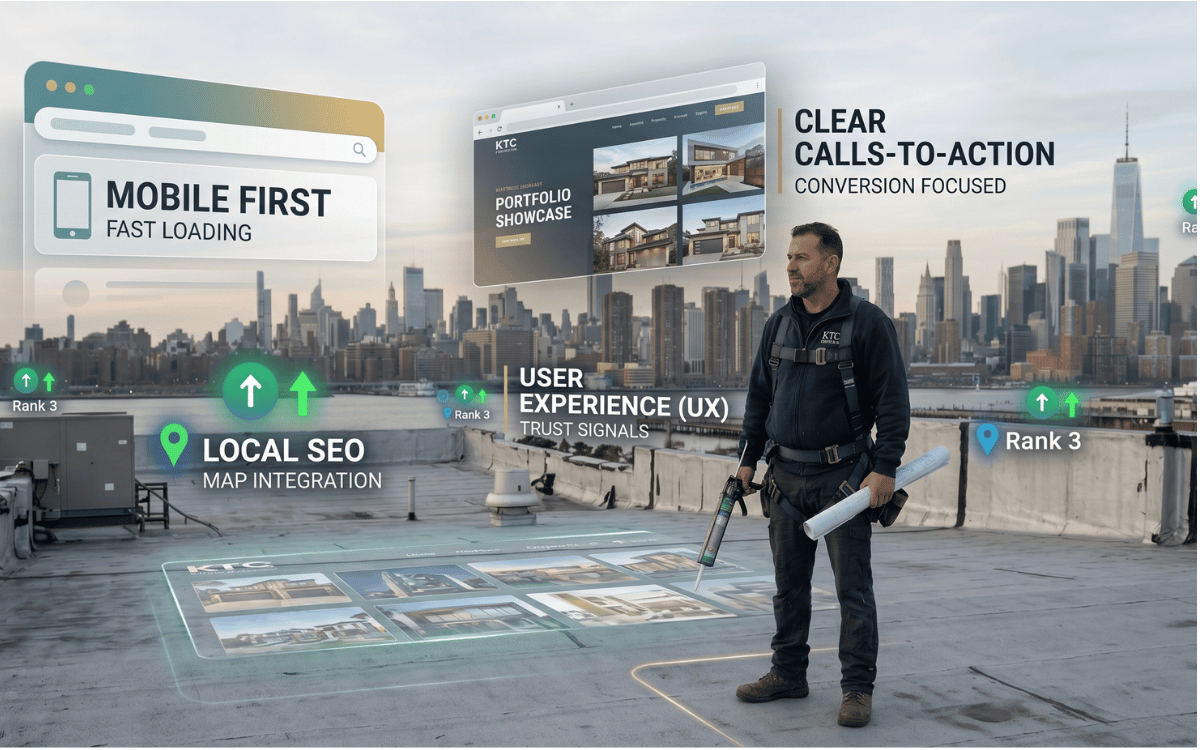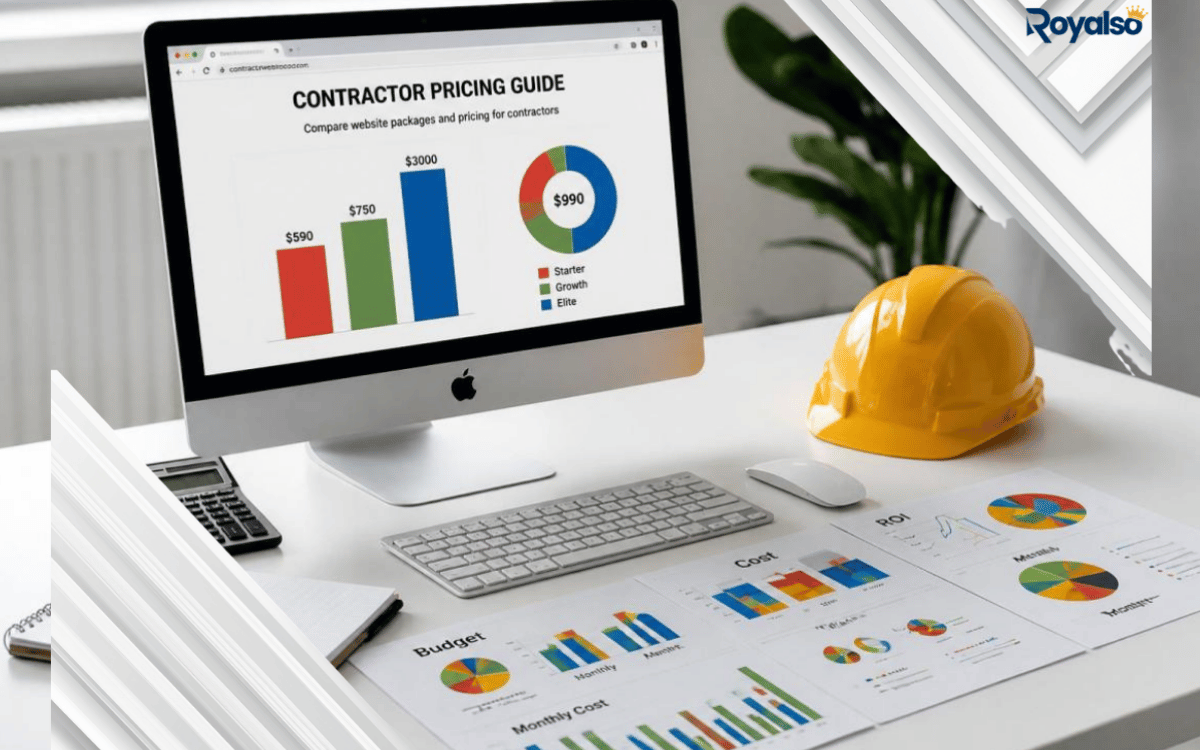
The short answer: a contractor website costs anywhere from a few hundred dollars for a do-it-yourself builder site to $15,000 or more for a custom build with a page for every service and town. Where yours lands depends on how many pages you need, who writes them, and what the site connects to.
- Do-it-yourself builder: roughly $500 to $1,000 all in, plus your time, according to published price guides (OptinMonster).
- Freelancer: usually billed by the hour, commonly $30 to $200 an hour (OptinMonster), so the total depends on the scope you hand over.
- Professionally designed small site: $500 to $5,000 and up (WebFX), with large custom agency builds running into the tens of thousands.
- Royalso: a Conversion Site Build is $7,500 to $15,000 one-time, depending on how many service and town pages you need, or included with Revenue Infrastructure and Multi-Market.
Below: what each option gets you, what moves the price, what to ask before you sign, and how to check whether it's worth it with your own numbers.
What you get at each price
| Option | Typical cost | What you usually get | Best for |
|---|---|---|---|
| Do-it-yourself builder (Wix, Squarespace) | Roughly $500 to $1,000 all in, plus your time | A template and a handful of pages you write yourself, on the builder's hosting | A new business that needs to be findable this month |
| Freelancer | $30 to $200 an hour | A theme set up with your words and photos; quality depends on the person | A small site when you can supply the content |
| Small professionally designed site | $500 to $5,000 and up | 5 to 10 pages, a stock layout, basic SEO settings | A brochure site, not a lead source |
| Contractor conversion build (our range) | $7,500 to $15,000 one-time | A page per service and per town, your photos, fast on a phone, forms wired to follow-up, call tracking | A contractor who wants the site to bring calls |
Want to know where your current site stands? Get my free audit. You'll get your PageSpeed result on a phone and a straight answer on whether you need a new site.
Tier 1: A do-it-yourself builder
Wix, Squarespace and similar builders let you put up a decent-looking site in a weekend for a monthly fee. The limits show up later. You rent the platform, and a Wix site can't be moved to another host (Wix Help Center). You write every page yourself. And a heavy template with big photos can be slow on a phone. It's fine to start with, and rarely enough to compete in a busy county.
Tier 2: A freelancer
A good freelancer can build a solid site at a fair price. Quality varies widely, so judge them by sites they've built for other contractors, not by how their own portfolio looks. Ask who hosts the site, who updates it, and what happens if they're unavailable in a year.
Tier 3: An agency build for contractors
An agency that works with contractors should arrive with a page plan for your services and towns, write the content, wire the forms into follow-up and track calls. That's where the money goes. Ask to see the PageSpeed result on a phone before you pay the final invoice.
What moves the price
- Number of pages. Every service page and town page means research, writing and photos. Page count moves the price more than anything else.
- Who writes the content. Handing over finished text costs less. Having the builder write it from an intake form costs more and usually reads better to customers and to Google.
- Photos. Your own job photos cost nothing extra. A photographer or licensed photos cost more.
- Connections. Call tracking, a CRM, online booking, financing forms and follow-up texts each add setup work.
- Speed work. Getting a photo-heavy site to load fast on a phone takes time: compressed images, fewer plugins, careful scripts.
- Moving an old site. Redirecting old web addresses keeps what you've earned in Google. Skipping it costs rankings.
- Care after launch. Updates, backups, security and small edits.
Monthly costs after launch
Plan for hosting, a domain, theme or plugin licenses and maintenance. Hosting alone runs from a few dollars a month for basic shared plans (OptinMonster) to far more for managed hosting (WebFX). Ask for each cost as its own line in the quote, and ask whose name each account is in.
At Royalso, hosting is on your own account and the domain is in your name. Ongoing WordPress maintenance is part of every retainer; on its own, it's quoted separately.
What to ask for in a quote
- How many service pages and town pages are included, and who writes them?
- Will it load fast on a phone, and will I see the PageSpeed result before the final payment?
- Are the domain, the hosting and the website in my name?
- Can I edit pages myself afterwards, and will you show me how?
- Where do form submissions go, and does anyone get a text when one comes in?
- Is call tracking included, and does my main number stay on Google?
- If I already have a site, will you redirect the old addresses?
- How long until launch, and what do you need from me?
- What's the payment schedule?
- How long are fixes included after launch, and what does maintenance cost?
Is it worth it? Run the math with your numbers
Work it out from gross profit per job, not revenue: the site's cost divided by your gross profit per job is the number of extra jobs it needs to pay for itself.
Example, with made-up numbers: a roofer with a $9,500 average roof job and a 30% gross margin makes $2,850 gross profit per job, so a $9,000 website pays for itself after three to four extra roofs. A plumber with a $650 average job and a 50% margin makes $325 per job and needs about 28 extra jobs to cover the same site. Put in your own average job and margin before you decide.
If the math doesn't work for your trade yet, spend less on the site and more on your Google profile and your follow-up first. Our contractor website tips list the fixes that cost little or nothing.
What a Royalso build includes
- WordPress with Divi. You can edit any page yourself afterwards, and we show you how in a 20-minute video.
- One page per service you want more of and one per town you serve, written by us from a short intake form you fill in once.
- A project gallery with before-and-after photos, laid out for a phone.
- A tap-to-call button fixed on screen and one short form, both wired into GoHighLevel so the AI follow-up fires within 60 seconds.
- Rank Math set up: titles, descriptions, headings, LocalBusiness and Service schema, and the sitemap submitted to Search Console.
- Speed tested on a phone before launch, and you see the PageSpeed result.
- Google Analytics 4 with lead events, and call tracking.
- Hosting on your account, the domain in your name, and the logins in your password manager.
It's $7,500 to $15,000 one-time, depending on how many service and town pages you need, or included with Revenue Infrastructure and Multi-Market. Half is due at signing and half before launch. Most sites are live three to four weeks after the intake form comes back, and thirty days of fixes after launch are included. See contractor website design for the full process.
Questions about contractor website pricing
How much does a plumbing website cost?
The same factors apply as for any trade: how many services and towns need their own pages. A plumbing site with pages for water heaters, drains, repiping and emergency service, plus the towns you serve, is a typical Conversion Site Build at $7,500 to $15,000. Our plumbing marketing page shows how the site works with Google Maps and ads.
Are there monthly fees for a contractor website?
Hosting, the domain and maintenance are ongoing costs with any website. With Royalso, maintenance is part of every retainer and quoted separately on its own, and hosting stays on your own account.
How long does it take to build a contractor website?
Most Royalso sites go live three to four weeks after your intake form comes back.
Is a cheap site ever the right call?
Yes, when you're starting out and need to be findable now. Make sure it shows your phone number, services, towns and real photos, and plan to replace it once you want the site to bring in work.
Not sure your site needs replacing?
The audit tells you, with the numbers: your PageSpeed result on a phone, whether you have a page for each service and town, and what happens when someone sends your form after hours. A video and a written list within one business day, by email, with no sales call.